In the Wake of New "360 Deals," A Reminder of Perhaps the Most Unfair Major Label Practice Should Prompt Further Independence
By Amir Said (Sa'id)
Music, easily one of the most important components of American culture, is everywhere: radio, t.v., the internet. So you'd think that recording artists, the bedrock of music itself, are well-paid. Think again. Sure, some of the A-List recording artists score fat royalty checks, (in addition to huge concert/show paydays). But the overwhelming majority of recording artists (the the B,C, D-list, and even some A-list artists) never see a royalty check throughout their entire recording career.
The reason why most recording artists never see a royalty check is because the music business is (and has always been) a legalized form of loan-sharking. The comparison of a bank loan is the most popular analogy of how paydays to artists work in the music business. The idea is that a record label loans money to a recording artist for the purpose of creating new art. When this new art is marketed and sold, there is a split in profits between the label and the artists. The split is typically 88-93% for the label, and 7-12% percent for the artist. In other words, artists routinely sign a deal that gives them a base rate of 7 to 12 cents on the dollar. Throw in a 5 cent royalty for each song that an artist writes on the album, and a recording artist can earn up to 40 or 60 cents per album.
But slow down, it's important to remember that the masters of this newly created art belongs 100% to the label, (unless some proportional agreement is made to stipulate otherwise, which of course is extremely rare). Though the artist is entitled (supposedly) to a cut of the returns, there is no split in ownership between the labels and the artist! And as such, it is the label's right to withhold royalty payments, or rather apply them to the debt of the artist (all monies the label spent on the artist) until it is resolved. When an artist has repaid his entire budget they are said to be fully recouped. But typically, artists never fully recoup. And thus, it's very common that artists wind up owing their label indefinitely.
This is why the bank loan analogy that many people use is grossly inadequate. Indeed, a bank loan for consumers with the most despicable credit scores is more favoring than the loan terms that recording artists routinely agree to in a standard recording contract. For example, when a person with absolutely flawless or appalling credit receives a car loan, they gain 100% total use of a new/used car. For all intents and purposes, the car belongs to them. At anytime within the agreement, this person can refinance or actually sell the car. Moreover, at the end of the agreement—usually no longer than five years—the car belongs to them free and clear. In the old music business, recording artists almost NEVER own their work, even after the initial agreement that they entered in is long over. Even worse, the only actual right to use that artists retain of the music that they create is the right to perform it at concerts and such. They can not however resell it, without the permission of the label that they're signed to.
Editor's note. "In order to make better business decisions now and in the future, it's important to understand the history of the music industry's business practices in the past." — Amir Said (Sa'id)
For example...
Check out DJ Jazzy Jeff (pre-Will Smith Hollywood fame) as he talks about the highs and lows of winning a Grammy.
Unsung Hero of Creativity, Large Professor Mastered the Art of Bass-Filtering and Drum-Sound Customization
By Amir Said (Sa'id)
On "The Mad Scientist," one of Large Professor's best beatworks, it will serve you well to notice how the drums and the sample move together. Each drum sound is its own sample, yet when this song came out, many critics of sampling could not—did not—distinguish the individual drum hits that Large Professor used. Instead, in various "reviews," the drum sounds were incorrectly lumped together with the sample, and described as being simply "a part of the sampled riff." I can even remember reading one critic's assessment of "The Mad Scientist" as having a "lack" of creativity.
Well, the true fact of the matter is, there's a lot more going on with this track than many would easily recognize. First, each drum sound is customized and well-suited for the main sample, (which Large Professor uses like a break). The kick has what I like to call a rubber bottom. I use the term "rubber bottom" to describe those kicks that have significant bottom, but still manage to bounce. The snare, which sounds like a straight-forward snare sound with loose skin, snaps and suspends in mid-space, sustained by just the right amount of reverb. This is most pleasing to the ear, as it makes the snare sound much more fuller and balanced, unlike the over-compressed, "squashed" sounding snares in far too many of today's beats. Then there's the shaker-like hat that glides across the entire measure. (Underneath the main hi-hat there appears to be another light, truncated hi-hat that whispers.)
As for the main sample tha drives the beat, Large Professor speeds up its pitch, in a way that streamlines its warmth, without distorting its sonic value, or disrupting the drum framework. And the way that the sample is chopped, the beginning and end points are masked quite well, making the loop sound like two overlapping parts that dissolve into each other. Finally, there is one notable change: the ascending violin phrase (sample) that streams through the chorus section.
Looking back, I remember how I thought to myself that once critics start to challenge the creativity of drum patterns/programs, sampling would really come under attack by other beatmakers. Unfortunately, I was right. But I also believed that there would be more beatmakers who would disagree with the mostly uninformed critics of beatmaking and its various creative, often meticulous practices. Fortunately, I was right about that, too.
Large Professor - "The Mad Scientist" (Instrumental)
Large Professor - "The Mad Scientist" (Official music video)
Less We Forget, Music Appreciation is Also Learned Behavior
By Amir Said (Sa'id)
Many 20- and 30-somethings are betraying their kids. Worst part is, most (if not all) don't even know it. In fact, many of them don't even have kids yet. Bizarre? Nope, stick with me for a moment...
The parent/child relationship is not merely a testament of love, it's an agreement. For better or worse, when a man and woman (intentionally or unintentionally) have a child, they, in effect, sign on the dotted line (willingly or unwillingly), and agree to provide nourishment for their child. This nourishment can take on many forms other than the standards of food and shelter. In fact, the one form that plays one of the greatest roles in American culture is musical nourishment.
In today's world of hyper-active marketing, massive numbers of people willfully endure promotional practices that are designed to seemingly shame them into buying products, regardless of their quality or merit. The idea is to just pile-drive the concept of conspicuous consumption into the minds of people, and then turn them into a zombie-race of conspicuous consumers, who buy into to the "what's in" or "what's hot" line, without any critical analysis of its creativity or actual worth. And all it takes to set this dastardly chain of consumption into motion is this: Take one so-called "taste maker" and/or widely considered "hip" person, have them announce that they like something, (typically, without ever clearly saying why, and using some retro slang that they don't even understand, like "dope" for instance), and boom...product sold, zombies unite!
Parents are supposed to screen their children from becoming zombies. That is to say, in no small degree, they are charged with nourishing the musical education and understanding of their children. In the early part of our lives, mostly everything we learn about music comes directly and/or indirectly from our parents. Well, at least that's how it used to be. These days, the marketers, promoters, hype people, and the media-massives that back them, have figured out that the earlier you can convert someone to a zombie, the better the chance at suckering them into buying woeful products for the rest of their lives! So as it is, on the pop side of things, kids are shot at with boy-band bullets and stabbed with out-of-tune (and autotune) tween Madonnas. On the "urban" side of things, (read black, hip hop/rap, and R&B), the youth are strangled with winey, often incoherent vocals, meaningless concepts, and rampant duplication. And yes, bi-partisanship is in full effect in hip hop/rap and R&B; underground and commercial.
Sometime ago, the notion was passed on that kids are not supposed to like, relate to, feel, and/or understand the music of their parents. Here, I have to provide some sobering context. This "hate your parents music" complex is rooted in the fact that during the middle of the twentieth-century, many white teens were breaking away from the chains of American-style racism, and consciously (publicly) listening to black music, then known as "race music." By the late 1960s/early 1970s, public attitudes towards race and music in America had all but inverted. And the children of these "radical" parents of the 50s, 60s, and 70s received a musical nourishment that underscored as much as 30 years of the highest quality of American popular music. It was these children who would go on to develop hip hop/rap music. It was these children that would get together and form groups like Metallica and Nirvana...
So what about the children of today and the children of the soon tomorrow? Are their parents, the now 20- and 30-something retro hip-stylers, going to be able to provide the quality musical nourishment that they deserve. Probably not. Moreover, by then, these parents will be so accustomed to labeling their own kids as "haters" (some do already) that the brightest kids will simply reject their parents and see to their own musical nourishment. I mean, let's open up the hood on this one: will the children of now be impressed with their parents and their music, finding a new level of respect for their parents? Or will they be so utterly unimpressed with their parents musical choices that they begin to question and reject other qualities about their parents? My grandmother really liked Mahalia Jackson and Aretha Franklin... My mother really liked Mahalia Jackson, Aretha Franklin, and The Miracles... I like Mahalia Jackson, Aretha Franklin, The Miracles, and Curtis Mayfield. But 10, 20, 30 years out from now, will the then "grown-ups" like Lil Wayne and Drake? That's not a knock against these two, it's a valid question from someone who received a great deal of musical nourishment and did NOT ignore and/or reject it...
And as to why I'm not so easily impressed by any of the so-called "R&B artists," of today, well, below, I present to you Aretha Franklin.
For Mix Engineers, Hip Hop/Rap Presents a Set of Challenges
Interview with Mix Engineer, Cus, as told to Amir Said (Sa'id)
Sa'id: What’s the biggest challenge when it comes to mixing hip hop/rap music?
Cus: [Laughs] The biggest challenge to me, and it’s not really a big challenge for me anymore, but it’s one of the things that I would tell people is that Hip Hop is really drum driven, so understand: once you turn up one thing, you gotta turn up other stuff. So once you try to make the drums as big as you can, you gotta make everything else bigger, especially the bass line. So the whole thing is to try to give it as much maximum power as you can, without over killing it.
Sa'id: What sets mixing hip hop/rap apart from other genres of music? Is it more challenging mixing a typical rock song or a typical Hip Hop-Rap song?
Cus: I do both, so I don’t have a problem with any of them. But an engineer more so used to mixing Hip Hop would have a problem mixing rock. You have to understand that the bass lines in Rock music are not really over everything, they’re just an undertone just to keep along with the drums. Whereas a bass line in hip hop a lot of times is the actual melody, (in a sense), ‘cuz it may not be that much instrumentation. Plus, the bass line is supposed to drive everything. So the bass line is supposed to be on top, where as opposed to Rock music the bass line is supposed to be just a simple undertone to carry the drums, where the guitars are on top!
Sa'id: How did you become a mix engineer?
Cus: I went to Queensborough Community College for Audio Engineering. I started in ’91. In ’93 I started interning at the infamous Powerplay Studios in Long Island City. I graduated [from college] in ’94… Powerplay was a studio that used to house such clients as Diggin’ In The Crates, EPMD, Boogie Down Productions… everybody came through Powerplay. One of the first mixes that I assisted was the “It Ain’t Hard to Tell” Remix with Nas, produced by Large Professor. Interning was interesting, ‘cuz I was able to get into the rooms more. And as I was assisting, I started to get small gigs engineering… After I really started engineering, this was like the tail end of ’95, the beginning of ’96, I started to do some assisting at Unique [Unique Recording Studios-NYC], so I was back and forth engineering at Powerplay and assisting at Unique… Then in ’97 I was full fledge mixing at Unique!
Sa'id: What was the thing that took you to that next level, from assistant to full time engineer?
Cus: I don’t really remember what session it was but… people just like throw you in the fire. Other established engineers would be like, I don’t feel like coming in, all they’re doing is vocals. Yo, you go ahead and do it. (So that’s how I caught a lot of gigs, in the beginning).
Sa'id: What areas should you be concerned with, when mixing Hip Hop-Rap music?
Cus: DRUMS! After you get your drums right, everything else falls into place. Once you get your drums right… I’ve been in situations where I’ve mixed songs and something was wrong with the drums and it made the whole mix go haywire. And as soon as I got the drums perfect, to my liking, I didn’t even have to do anything to the other stuff. If you get your drums in place, then every thing else follows suit.
Pablo Gad, a Gem of Late 1970s/early 1908s Reggae, Serves Up Lessons; Dub Proves to Be Useful for Coming Up with New Drum Sound Techniques
By Amir Said (Sa'id)
Overlooked by most, save for the die-hard reggae (dub) fans, Pablo Gad is pure gold. His vocal styling is distinct, and his cadence haunts with a depth and direction reminiscent of American soul-stirrers. But the added benefit to a Pablo Gad track is the dub instrumentals that often accompany the vocals.
Studying dub instrumentals has helped me to better understand the sort of sound textures that individual drum hits can make, when layered (dubbed) over themselves. Over the years, layering drum sounds—most specifically for the purpose of creating custom drum sounds—has played a major role in the development of my style and sound. Also, the ways in which dub tracks are typically mixed have helped me expand the ways in which I "pre-mix" my sounds.
Pablo Gad - "What Makes A Natty Dread Cry"
Pablo Gad - "Hard Times" (One of my favorite records)
"People are not precise. So why should it follow that music is precise? Just like the way people move, music is made within parameters. And these parameters are stable in some areas, yet fluid in others. Thus, musically, we are the sum of our knowledge, likes, and dislikes." — Amir Said (Sa'id)
For Beatmakers, the Key to Extending Range is Mostly About Focusing on The Core
By Amir Said (Sa'id)
When most beatmakers talk about "range," what do they mean? Are they talking about a beatmaker's abilities to make beats in a variety of different styles? Are they talking about a beatmaker's ability to make both sample-based and non-sample-based beats? Are they talking about a beatmaker's knack for incorporating a plethora of influences into their beats? I suspect that all of the above descriptions are accurate. However, that being said, I do not think that "range" is something that is ultimately achieved through the mastery of different styles.
Building range within your beatmaking skill-set is not about conquering different styles. In fact, for me, range simply means a beatmaker's ability to translate his (or her) core style and sound to any type of beat he (or she) makes. For example, I can make beats with or without samples. However, my core style and sound is predicated squarely within my sampling roots. This means that no matter what type of beat that I'm making, I always approach it with the same sensibility that I use when I'm sampling.
More specifically, when I make non-sample-based beats, I'm steadfastly focused on carving out a real tight groove. Even when adding embellishments or key-stacks, I'm doing so in a way that is consistent to how I chop and truncate samples. In this way, I stay true to my core style and sound, while consistently increasing my range.
For example...
Below, I have included several examples to further illustrate what I mean. Each beat was made by me. And although each track may appear to be dramatically different, each are well within my core style and sound.
This first example is a non-sample-based track, called "Double Cross." I should point out that although I originally played all of the keys and the bass lines live—in real time, I ultimately decided to sample my own live playing, and program each keyboard (synth) phrase right over the drum framework.
Sa'id - "Double Cross"
This second example, "Radio Pirate," (a song about me bum-rushing a "fake" hip hop radio station), is a sample-based track, complete with me rhymin'. For this song, I sampled a small musical phrase, chopped it up, and looped it tightly. From there, I built a drum framework that was aggressive, but not too overbearing.
Sa'id - "Radio Pirate"
Finally, this third example, "Deal With It," is a combination of samples and synths, but you will notice that it's the groove that still drives the joint all the way home. Again, here, my core style and sound is well represented. Also, I'm rhymin' on this track, too.
Many of Today's Beatmakers Seek to Reference the Here and Now, Not the Music Well of the Past
By Amir Said (Sa'id)
In the movie, Mo' Better Blues, there's a part where trumpeter and bandleader, Bleek (Denzel Washington) leads the quintet in an original, hip hop-inspired composition. The purpose of the piece, (as we learn in the film), is to give the people "what they want." Therein lies one of the major themes of Mo' Better Blues: How to remain commercially relevant, while playing jazz—a music form that has mostly lost its broad-based common appeal in the contemporary music landscape.
For Bleek, (who's torn as much between the choice of two women as he is between the choice of "selling out," and not playing the kind of jazz that's in his heart), it's important to maintain a connection to the essence of the Jazz Age (ca. 1930s-1950s), an era long gone. At various places within the film, we see his attempts to maintain this connection. In one scene, he laments about how jazz used to be. In another scene, we see how he guards his jazz record (vinyl) collection. And, in perhaps one of the most telling scenes, we see Bleek's commitment to practice—a practice regiment intentionally similar to saxophone legend, John Coltrane.
Although Bleek is firmly committed to keeping an emotional, mental, and stylistic connection to the essence of the Jazz Age, he is at all times acutely aware of the commercial realities of contemporary jazz. The club that Bleek's band headlines is pricey. For every one of his band's performances, there's a huge line, yet Bleek is troubled. In one scene, he complains to band mate and nemesis, Shadow (Wesley Snipes), about the lack of black people who attend his own performances. But what's even more disheartening to Bleek is his realization that the people who attend his shows have no idea what real jazz (the jazz age) sounds like.
Later in the movie, Bleek leads the band in the tune, "Mo' Better Blues," his ode to the style of jazz that he knows he will never be able to let go. After finishing the incredibly moving, "Mo' Better Blues," Bleek walks off the stage, refusing to perform another song. It is at this precise moment that Bleek realizes he no longer has to struggle to maintain a connection to the musical past; he knows that it's in him, and he's content with the fact that, for a moment, at least, the club-goers were able to take in a piece of music that was well within the jazz tradition he so admires.
For me, this story in Mo' Better Blues is analogous to the contemporary beatmaking climate. Like Bleek, there are some beatmakers who look to uphold the essence of the hip hop/rap music and beatmaking traditions. Unfortunately, however, there are many more, increasingly, who do not. Perhaps the best evidence of this is a brief exploration of the base influences that beatmakers reference.
In the 1970s, DJs (beatmakers) referenced early funk-makers. In the 1980s, beatmakers continued to reference early funk-makers, while expanding their references to include late funk, rock, and electro pop. In the 1990s, beatmakers further expanded their musical references to include jazz and a return to soul. Thus, between the early 1970s and the mid-1990s, beatmakers, by and large, referenced the vast music well of the past. Here, it's important to point out that this does not mean that during this same period, beatmakers did not reference each other. Of course, they did. It is impossible for beatmakers—like any other artists—to not be influenced (in some way) by the work of their contemporaries. However, it's worth noting that for more than 25 years, most beatmakers referenced a healthy balance of the past and their present. And it should be noted that many looked to the past, not only for inspiration and understanding, but for cues on how to create new sounds in the future.
But in recent years, referencing the past music well has increasingly become an unfamiliar practice for many beatmakers, who have, instead, chosen to flock—in clone-like droves—towards referencing only the music of their contemporaries. Such a trend, which, for all intents and purposes, flies directly in the face of one of hip hop/rap's most fundamental traditions: referencing (and studying) what came before, in order to be the sound- and style-leaders of the future.
Again, referencing the music (sounds and styles) of one's contemporaries is certainly not a bad thing for beatmakers. In fact, I support and encourage the practice. But I'm not in agreement with the notion of referencing one's contemporaries only. To me, I see that as a beatmaker's dereliction of artistic duty. For without some conscious link to the essence of the hip hop/rap music and beatmaking traditions, a beatmaker is more likely to ignore what came before. And by ignoring what came before, (whether due to contemporary commercial realities and/or some other concern), in favor of what "is now," a beatmaker, in effect, disconnects him (or herself) from the musical well of hip hop/rap and other musics of the past.
Thus, for me, Mo' Better Blues serves as a cautionary tale for beatmakers. If we do not want to go the way of the jazz legends; if we do not want hip hop/rap music to lose its cultural and commercial relevance; if we do not want hip hop/rap music to become something witnessed and experienced only by one affluent ethnicity, inside of plush, pricey clubs; then, I suggest we temper our musical referencing of the "here and now," and increase our referencing of the vast musical well of the past. Indeed, to strike such a balance means to enrich one's overall musical understanding. It also helps assure the survival of the hip hop/rap music tradition.
"Mo' Better Blues" (By Terrance Blanchard, performed by Brandford Marsellis Quartet)
Trap Music at Its Best; the Groove and Snare-Layering Techniques Makes Beat Sore
By Amir Said (Sa'id)
There's nothing like the real article. And as far as "trap" music goes, no one has—and I suspect none will—ever do better than DJ Toomp. Here on "U Don't Know Me" (Urban Legand, 2004), DJ Toomp personifies the trap music sound: a bottom heavy core groove, mid range synth accents and embellishments, and, of course, the 808 syncopated snare and hi-hat.
Unlike the most recent renditions of the trap sound, on "U Don't Know Me," DJ Toomp separates himself from the pack by not opting for an extreme minimalistic approach. Although the core groove is solid and hypnotic, it's the accents, embellishments, and masterful layering that Toomp works in that gives the entire track a broad, orchestral-like composite.
While the 3-note bass line and full-bounce kick are anchoring the groove, Toomp drops in a futuristic, 1-note synth stab on "the one" of every measure. Then on every fourth bar, he works in a 3-note synth-stab. And to make the ends of the fourth and eighth bars flourish and turnover (loop) more emphatically, he breaks up this 3-note synth-stab, and uses each note to play a quick descending pattern, where the last note slides in, right before the first kick lands.
Finally, in a moment of sonic defiance, Toomp ignores the harmony and melody that he's developed, (going against less-able beatmakers' intuition), and layers in this eerie, iron-sustained synth-stab, right over the top of a clap, which is itself layered over the top of another snare. The result is a tri-layered snare that sounds like a crowbar striking up against an underground subway pipe. But Toomp doesn't stop there with his layering work. He dulls the front-end attack of the "actual" snare and the iron-synth sound-stab, while he prolongs the back-end sustain of the "iron layer." And in the mix of the song, he opts to sometimes drop the iron layer altogether, leaving the clap to fend for itself.
Taken together—the choice of the combination of sounds, the layering, and the attack and sustain effects—and this snare comes off more like it's guarding the hardness of the beat than it is helping to keep time.
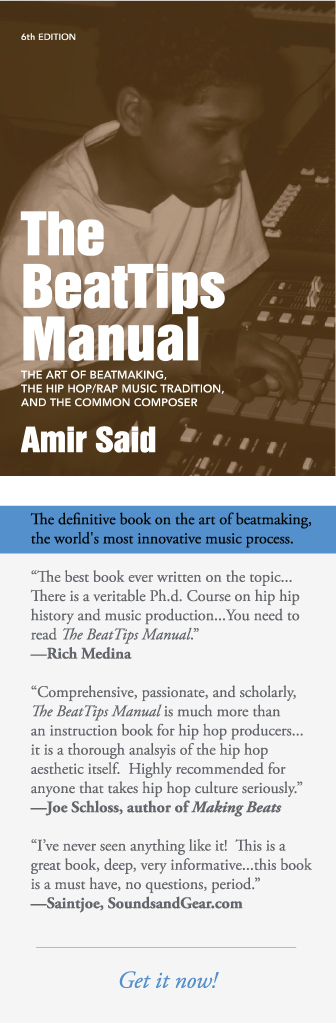
"I have been producing beats for a number of years now, and finding this caliber of literature is not always easy. Your book is ridiculously tight, your enthusiasm, knowledge and passion for the culture is spilling from each page. Your writing style is so, that I couldn’t put the book down, I rolled meticulously from cover to cover I didn’t want to miss a sentence. This book has inspired me in a big way, so for that, I wanted to thank you. Keep doin what you do." — Phil Rose
"Sa'id, I just got my copy of The BeatTips Manual, and I LOVE it. I've been producing for about 4 years now, and I've read all sorts of books, websites, forums and instructional videos, and I can honestly say, that this is by far THE BEST aid I've ever found. You can really feel your passion for beatmaking & producing, and that's what makes it such infectious reading." — Nick "Stealf" Lester
"I just wanted to thank you for this new 5th edition of The BeatTips Manual...it's beautiful! You are doing a great job and I wish you much success." — Chiemela (aka AC)
"Great work! Truly." — Dream Hampton, former Editor of the Source Magazine; Senior Writer for Vibe Magazine
"Just got the book today and its one of the best books I ever purchased for music production. I cant stop reading it..." — Phong Nguyen
"First and foremost, let me thank you, a lot, for your effort. I imagine writing it should have been a pretty tough task. It's good to see there are people trying to get hip/hop culture to the next level and being able, at the same time, to stay true to its origins. I could go on and on pointing out everything I loved about the book, but I won't because it'll take forever. The essence of the book is really, really good. You sound like someone who knows exactly were he's coming from and knows exactly were to go. Let me thank you again and congratulate you for a great work. It really was a pleasure reading it, and it'll sure be really close to my production set-up. I hope the Manual hits hard in the streets, the studios and in the academic world." — Dante
"Awesome guidebook. A great asset for any producer. Well written." — Shusaku3000
"Great Book! If you produce beats, buy this book. You will not regret it." — Karma
"THIS BOOK IS THE TRUTH! It delves deep into the philosophy of the producer, important comparisons of different styles, hip hop history, business, and tons of up close and personal interviews with hip hop's largest producers. All the pages are written in a down to earth, coherent manner so everyone from beginners to advanced producers can benefit. Highly recommended." — Turntable Lab
"This is by far the single best book focusing on Hip Hop production. It is an absolute must read and it's for anyone beginning or continuing their journey into production. It will prove highly valuable and pay countless dividends to anyone willing to invest the time to obtain the vast wealth of knowledge and wisdom contained in its pages. Also, with interviews from renowned producers such as DJ Premier...and others being worth the price of admission, the book acts as a triple bonus." — CrateKings.com
"You Must Learn. The BeatTips Manual goes way beyond beatmaking 101. There's only so much you can learn about hip hop production from audio technology schools, where the art form's finer points are generally glossed over. Sa'id's accessible BeatTips Manual fills in the blanks. It shines in its efforts to educate readers on topics that are often overlooked. Do the knowledge!" — SCRATCH Magazine
Recent Comments